

Octogen

Octogen Resources logo - walkie talkie supplier Malaysia
Obor Kuasa Logo

Case Study: Meridian Construction × Octogen — 850 Workers. 48 Floors. One Near-Miss Changed Everything.

Case Study·Construction·Malaysia8 min read
Meridian Construction Group × Octogen · 2024–2025

850 Workers. 48 Floors.
One Near-Miss Changed Everything.

How a crane load-swing incident exposed fatal communication gaps on a twin-tower construction site — and how Octogen deployed 150 walkie-talkies across 14 subcontractors in 9 days to prevent the next one from being real.

0
Workers On-Site Daily
0 Units
Walkie-Talkies Deployed
0 Floors
Active Construction
0
Safety Incidents Since
Scroll down
ClientMeridian Construction Group
ProjectPinnacle Heights Twin Towers (48F Mixed Dev)
Scale850 Workers / 14 Subcontractors
LocationIskandar Puteri, Johor
EquipmentMotorola DP4800e x150 + 3 Site Repeaters
Service DateNov 2024 (Ongoing until T.O.P.)
Choose your perspective

Which role are you? This project looks different from every angle.

“I had 14 subcontractors and 850 workers on-site. When the crane incident happened, I found out 90 seconds later from a runner. On a construction site, 90 seconds can be the difference between a near-miss and a fatality.”

You need every foreman on every floor to reach the safety team instantly. The near-miss incident section is the moment that changed the way this project communicates. The DOSH compliance timeline in the Solution Steps is where this becomes a regulatory story.

“Before Octogen, my emergency drill response time was 4 minutes and 20 seconds. DOSH standard is under 2 minutes. After deployment, we hit 47 seconds. That is not an improvement — that is the difference between a fine and a fatality.”

You care about DOSH compliance, emergency response time, and whether your incident reporting chain works when someone is actually in danger. The System in Action dashboard shows real drill data — not theory.

“I have 60 workers spread across 12 floors. Before radios, if the crane operator needed to stop a lift, someone had to physically run up or down the stairs to tell me. Now I hear it in my ear before the load even moves.”

Your daily reality: concrete pours that need exact timing, crane lifts that need ground-level coordination, and M and E installations that block structural work if the schedule slips. The channel design section shows how 6 frequencies eliminated the shouting.

“When I calculated the cost of one DOSH stop-work order versus 14 months of walkie-talkie rental, the rental was less than the penalty for a single day of shutdown.”

You care about cost justification and VO avoidance. The cost comparison tab shows why rental made more sense than purchase for a project with a defined completion date — and why the DOSH compliance cost was effectively zero versus the alternative.

The Challenges They Faced

These problems — you may have faced them too

① The Blind Floors

48 Floors Under Construction — 22 with Zero Communication

A twin-tower construction site is a vertical RF nightmare. Exposed rebar acts as a signal cage. Concrete cores block frequencies. Basement excavations create total blackout zones. At Pinnacle Heights, standard handheld radios could not reach beyond 3 floors in either direction from any position. The basement levels B1 through B4 — where 120 workers operated excavators and pile drivers daily — had zero radio contact with the surface.

  • Basement B1 to B4: total radio blackout. Excavator operators and pile-driving crews worked with zero comms to surface
  • Tower cores (lift shafts, stairwells): steel rebar cage effect blocked all UHF and VHF signals consistently
  • Above floor 30: wind noise + distance meant even shouting between floors was impossible during crane operations
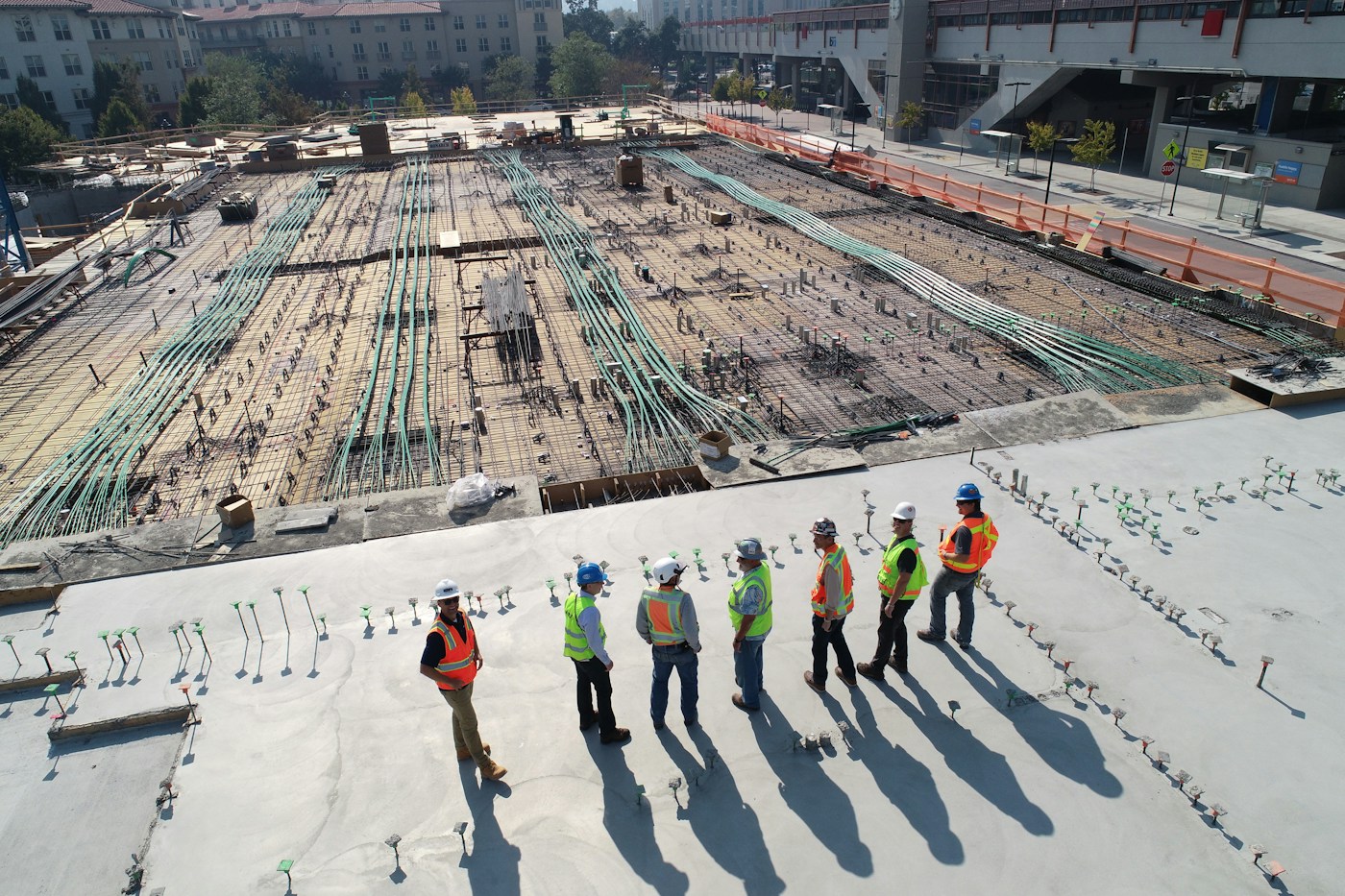
“My safety runner took 3 minutes to climb from B3 to ground level to report a gas leak alarm. By the time the evacuation order reached the basement, 8 minutes had passed. That is not a communication gap — that is a death trap.”— Ir. Ahmad Faizal, Project Director, Meridian Construction Group
② 14 Subcontractors, 1 Crane

14 Companies, 5 Languages, Zero Coordination Protocol

Pinnacle Heights had 14 active subcontractors on-site simultaneously: structural, M and E, facade, piling, formwork, plastering, waterproofing, electrical, plumbing, fire protection, ACMV, lift installation, and two specialist cladding teams. Each subcontractor used their own communication method — phone calls, WhatsApp groups, runners, or nothing at all. Tower crane operations required coordination between ground riggers, banksman, crane operator, and the receiving floor team — often spanning 40+ vertical floors.

  • Crane operations required 4-person coordination across 40+ floors — previously done by hand signals and shouting
  • 14 subcontractors used 9 different WhatsApp groups — critical messages buried under photos and memes
  • Language barrier: workers from 5 nationalities — Malay, Indonesian, Bangladeshi, Myanmar, and Nepalese teams
“The crane operator could see the load. He could not hear the banksman. The banksman could not reach the receiving floor. The receiving floor could not see the ground rigger. We were lifting 3-ton concrete panels on hand signals across 40 floors.”— Encik Hafiz, Senior Crane Operator, Meridian Construction Group
Purchase 150 Units + Licensing + MaintenanceOctogen Full-Service Rental (14 months)
RM 420k
RM 0
RM 455k
RM 72k
RM 498k
RM 168k
Rental saves 66% vs. purchase over 14-month project life — equipment returned at T.O.P., zero dead inventory

The Real Cost: One Stop-Work Order Versus 14 Months of Rental

After the near-miss crane incident, DOSH issued a formal improvement notice requiring documented site-wide communication capability within 30 days. Failure to comply would trigger a stop-work order — halting all construction activity until remediation was complete. For a project with an RM 280 million contract value and a penalty clause of RM 85,000 per day of delay, the maths was brutally simple.

  • DOSH improvement notice: 30-day deadline for site-wide comms compliance documentation
  • Stop-work order cost: RM 85,000 per day in contractual delay penalties to the developer
  • Equipment purchase option: 150 radios at RM 2,800 each = RM 420,000 upfront, plus licensing and programming
  • After T.O.P., purchased radios would have zero residual value — construction is a finite project
“The DOSH officer told me very clearly: fix your communication or I will stop your site. One day of stop-work costs us RM 85,000. Fourteen months of Octogen rental costs less than five days of shutdown.”— Ir. Ahmad Faizal, Project Director, Meridian Construction Group
The Turning Point

On September 17, 2024, at 2:14pm, a 2.8-ton precast concrete panel being lifted to floor 38 began to swing in crosswind. The ground rigger signalled stop. The banksman could not see the signal. The crane operator could not hear anyone. The load swung 4.2 metres — passing within 60 centimetres of two workers on the receiving floor. Nobody was hurt. But when the incident report reached the Project Director 90 seconds later — via a worker who physically ran down 12 flights of stairs — the entire site was shut down for 48 hours.

That afternoon, Meridian Construction contacted Octogen. The instruction was simple: get us on air before DOSH comes back. Nine days later, 150 walkie-talkies were live across every floor of both towers.
The Solution

4 things Octogen did at Pinnacle Heights

Not a radio drop-off — a site-wide communication system built around construction safety workflows, crane operations, and DOSH compliance. Click each step to explore.

01
Construction Site RF Survey
Day 1 to 2
What we didThe Octogen RF team surveyed both towers from B4 to the active construction floor (then floor 34). Signal propagation was tested through exposed rebar grids, concrete cores, and across the 28-metre gap between towers. Basement levels B1 to B4 were confirmed as total blackout zones. Three repeater positions were identified: Tower A rooftop crane platform, Tower B floor 20 service riser, and the site office container compound at ground level. Output: a 6-channel frequency plan aligned to construction workflow, not just departments.
02
MCMC Licensing in 5 Days
Day 2 to 7
What we didOctogen filed 6 frequency licence applications with MCMC under expedited processing — supported by the DOSH improvement notice documentation. Channel plan: Ch1 Crane Ops (dedicated, always-on), Ch2 Safety and Emergency, Ch3 Structural Works, Ch4 M and E Coordination, Ch5 Ground and Logistics, Ch6 Site Management and Command. The crane operations channel was designated as priority-override — any transmission on Ch1 would interrupt all other channels simultaneously.
03
150-Unit Same-Day Deploy
Day 8
What we didAll 150 Motorola DP4800e units were pre-programmed at the Octogen facility: labelled by subcontractor, colour-coded by channel assignment, and loaded with the 6-frequency plan. Three site repeaters were installed at the surveyed positions. On deployment day, Octogen ran a floor-by-floor activation test from B4 to the active construction floor — every unit confirmed clear two-way audio. Total deployment time from truck arrival to all-clear: 6 hours.
04
DOSH Compliance Sign-Off
Day 9
What we didOctogen prepared the full DOSH compliance documentation package: site communication coverage map, frequency licence certificates, emergency channel protocol, crane operations communication SOP, and a live demonstration for the DOSH inspector. The site passed the compliance audit on the first visit — 21 days ahead of the 30-day deadline. The DOSH officer noted in the report that the crane operations dedicated channel was 'a model implementation for high-rise construction sites.'
System in Action

What a 48-floor construction site sounds like when it works

Real channel activity from Pinnacle Heights during a typical morning shift — crane operations, concrete pour coordination, and a safety drill that completed in 47 seconds.

Channel Usage (Peak Morning Shift)
Ch1 Crane Ops
94%
Ch2 Safety
68%
Ch3 Structure
82%
Ch4 M and E
71%
150 devices active · 2 towers · B4 to floor 48 · 0 dead zones
Coverage Status (Post-Deploy)
RelayAll Basements B1 to B4 okBoth Tower Cores okActive Construction Floors okCrane Platform and Rooftop okCoverage: 100% both towers (pre-deploy: 54%)
Live Comms — Crane Lift, 10:23am
10:23Rigger->Load secured. 2.4-ton panel ready for lift to F38. Clear below.
10:23Banksman->F38 receiving team confirmed. Wind speed 12 knots. Clear to lift.
10:24Crane->Copy. Commencing lift. All personnel clear swing radius.
10:26F38->Panel received F38 east bay. Landing good. Rigging released.
10:26Crane->Copy. Hook returning. Next load in 4 minutes.
4-person chain · B4 to F48 coverage · 47-second emergency drill time

6 channels · 150 devices · 2 towers · 14 subcontractors · 0 safety incidents in 14 months

Full Deployment Timeline

9 days — from near-miss to full site coverage

Day 0

The Near-Miss

September 17, 2024 · 2:14pm
  • 14:142.8-ton precast panel swings 4.2m in crosswind during lift to floor 38
  • 14:15Ground rigger signals STOP — banksman cannot see signal, crane operator cannot hear
  • 14:16Panel passes within 60cm of two workers on receiving floor — near-miss confirmed
  • 14:18Worker runs down 12 flights to report. Site shut down for 48 hours.
“Everyone kept saying 'close call, close call.' I kept thinking: next time, someone's family gets a phone call instead of their father coming home.”
Day 1-2

Survey and Channel Design

Octogen RF team on-site within 24 hours
  • Day 1Full site RF survey — B4 to floor 34, both towers, crane platforms, all basements
  • Day 122 dead zones identified. Three repeater positions confirmed. 6-channel plan drafted
  • Day 2MCMC expedited filing submitted with DOSH improvement notice as supporting documentation
  • Day 2Construction workflow analysis complete: crane ops channel designated as priority-override
“They surveyed 48 floors in one day. Nobody had ever mapped our communication gaps before. We just assumed radios don't work on construction sites.”
Day 8-9

Deploy and Compliance

150 units live in 6 hours · DOSH audit passed Day 9
  • 06:00Octogen truck arrives with 150 pre-programmed units, 3 repeaters, and all mounting hardware
  • 09:30Repeaters installed and powered. Floor-by-floor activation test begins from B4 upward
  • 12:00All 150 units distributed. Foreman briefings completed for all 14 subcontractors
  • Day 9DOSH compliance audit passed first visit — 21 days ahead of deadline. Site cleared to resume.
“Six hours. From truck to full coverage. I have waited longer for a concrete pump to arrive.”
14-Month Record

Safety Scorecard Since Deployment

November 2024 to Present
Safety Incidents0
Emergency Drill Time47 sec
DOSH CompliancePassed
Crane Lift Coordination100%
Stop-Work Orders0
The Results

Numbers don't lie

0
Safety Incidents
14 consecutive months — zero reportable incidents since deployment
0 sec
Emergency Drill Response
Previous drill: 4 min 20 sec. DOSH standard: under 2 minutes
0%
Site Coverage Achieved
Both towers, B4 to active floor, crane platforms included
0 Units
Walkie-Talkies Deployed
14 subcontractors, 6 channels, all pre-programmed and labelled
0%
Cost Saving vs. Purchase
Rental model: zero upfront, return at T.O.P., no dead inventory
0 Days
From Incident to Full Coverage
Survey, MCMC licensing, deployment, and DOSH sign-off in 9 days

On September 17, a concrete panel missed two of my workers by 60 centimetres because nobody could reach the crane operator. Nine days later, Octogen had 150 radios live across every floor of both towers — basements, crane platforms, everything. The DOSH officer who came to audit us said our crane communication protocol was a model for the industry. We have now operated 14 months without a single safety incident. I used to think walkie-talkies were a nice-to-have on a construction site. After that day, I know they are life-or-death infrastructure. Every site I run from now on will have Octogen on day one — not after someone almost dies.

A
Ir. Ahmad Faizal
Project Director · Meridian Construction Group
Common Questions

Things you probably want to know

Standard handheld radios struggle in construction environments because exposed rebar, concrete cores, and deep basements block RF signals. Octogen addresses this with strategically placed repeaters — typically at the crane platform, mid-tower, and ground level — that re-amplify and redistribute signals throughout the structure. Combined with MCMC-licensed frequencies (which provide cleaner, interference-free channels), this achieves full B4-to-rooftop coverage even through active construction zones.
Construction projects have a defined end date. Purchasing 150 Motorola DP4800e units at RM 2,800 each means RM 420,000 upfront — plus MCMC licensing, programming, and maintenance costs. At T.O.P. (Temporary Occupation Permit), those radios have zero use. Octogen's rental model costs approximately RM 12,000 per month fully managed — equipment, licensing, programming, maintenance, and replacements all included. Over a 14-month project, rental saved Meridian 66% versus purchase.
At Pinnacle Heights, Channel 1 was designated exclusively for crane lift coordination: ground rigger, banksman, crane operator, and receiving floor team. This channel was configured with priority-override — meaning any transmission on Ch1 would interrupt all other channel activity, ensuring crane safety calls were never missed or delayed by routine construction chatter. This design was specifically noted by the DOSH auditor as best practice for high-rise construction.
Yes — the approach scales down to any active construction site with 2 or more floors, basement levels, or multiple contractor teams. The core principle is the same: site-specific RF survey, licensed frequencies, repeaters positioned for the structure, and channel assignment aligned to construction workflow rather than department hierarchy. Octogen has deployed from 20-unit sites to 150+ unit projects using the same methodology.
The Meridian project was an emergency deployment completed in 9 days including MCMC licensing. Standard construction site deployments typically take 10 to 14 days. The process: Day 1 to 2 for site survey and channel design, Day 3 to 7 for MCMC frequency licensing, Day 8 to 10 for programming, delivery, repeater installation, and floor-by-floor activation testing. Expedited timelines are available when supported by regulatory documentation such as DOSH improvement notices.
All equipment is returned to Octogen. There is no disposal, storage, or depreciation cost for the contractor. If the building transitions to a property management phase requiring ongoing communication (security, maintenance, concierge), Octogen can redesign the system for the operational phase — often transitioning from construction-grade repeaters to a permanent BDA installation, as was done at Puteri Harbour Residences.
Your site, your safety

Don't wait for a near-miss to fix your site comms

Meridian waited until a concrete panel almost hit two workers. You don't have to.