

56 Floors.
One Signal.
A luxury tower hotel replaced perfectly good Motorola P6600i radios three times — and never fixed the dead zone. One Motorola SLR5300 repeater solved what no radio upgrade ever could. Two years on, zero complaints.
Which role are you? This problem looks different from every floor.
“I knew there was a coverage issue for years. What I did not know was that no radio in the market could have fixed it — because the problem was the building, not the radios.”
You care about operational reliability across every floor, every zone, every shift. The hotel ran blind between its basement and upper floors for years, and the cost was not just in replacement radios — it was in guest service gaps and staff frustration. The Turning Point and Results sections show the clearest picture for your level.
“Basement parking was effectively a separate world. We could not reach them, and they could not reach us. For a security operation, that is not a gap — it is a risk.”
Your concern is response time and coverage continuity. A dead zone between your security desk and basement parking is a genuine safety vulnerability. The Signal Dead Zone challenge explains the root cause, and the System in Action section shows what reliable basement-to-tower communication actually looks like in real-time hotel ops.
“A VIP guest asks us to retrieve their car. We radio parking. Nothing. We try again. Nothing. Someone has to physically go down. That is the reality we lived with.”
Your team lives the service gap every shift. Valet, concierge, front desk — when communication with basement parking fails, it becomes a guest-facing problem in seconds. The Coordination Breakdown challenge is written directly for your experience, and the live comms log in System in Action shows what smooth ops looks like.
“Every time we replaced the radios and the problem persisted, I knew the radios were not the issue. I just could not prove it until Octogen ran the site survey.”
You suspected it was a structural problem before anyone else. The RF site survey confirmed your instinct — the Level 8 pool deck was the culprit, not the equipment. The Solution Steps and the cost comparison in the Hidden Costs challenge lay out exactly what the right infrastructure investment looks like.
These problems — you may have faced them too

The Signal Died Every Time It Crossed Level 8
The Corsair Hotel's 8th-floor swimming pool — reinforced concrete, steel rebar, and a full body of standing water — formed a near-perfect RF barrier running across the entire building footprint. Radios worked fine above Level 8 and below it, but the moment a call needed to cross that pool deck, it dropped. Basement-to-upper-floor communication was unreliable at best, completely silent at worst.
- Basement B2 parking: all incoming radio calls from Level 1 and above consistently dropped
- Levels 1–7 (below pool): marginal signal — 40% of calls failed to connect upstairs
- Security desk could not confirm parking status without physically going down
5 Teams, Zero Cross-Floor Confirmation
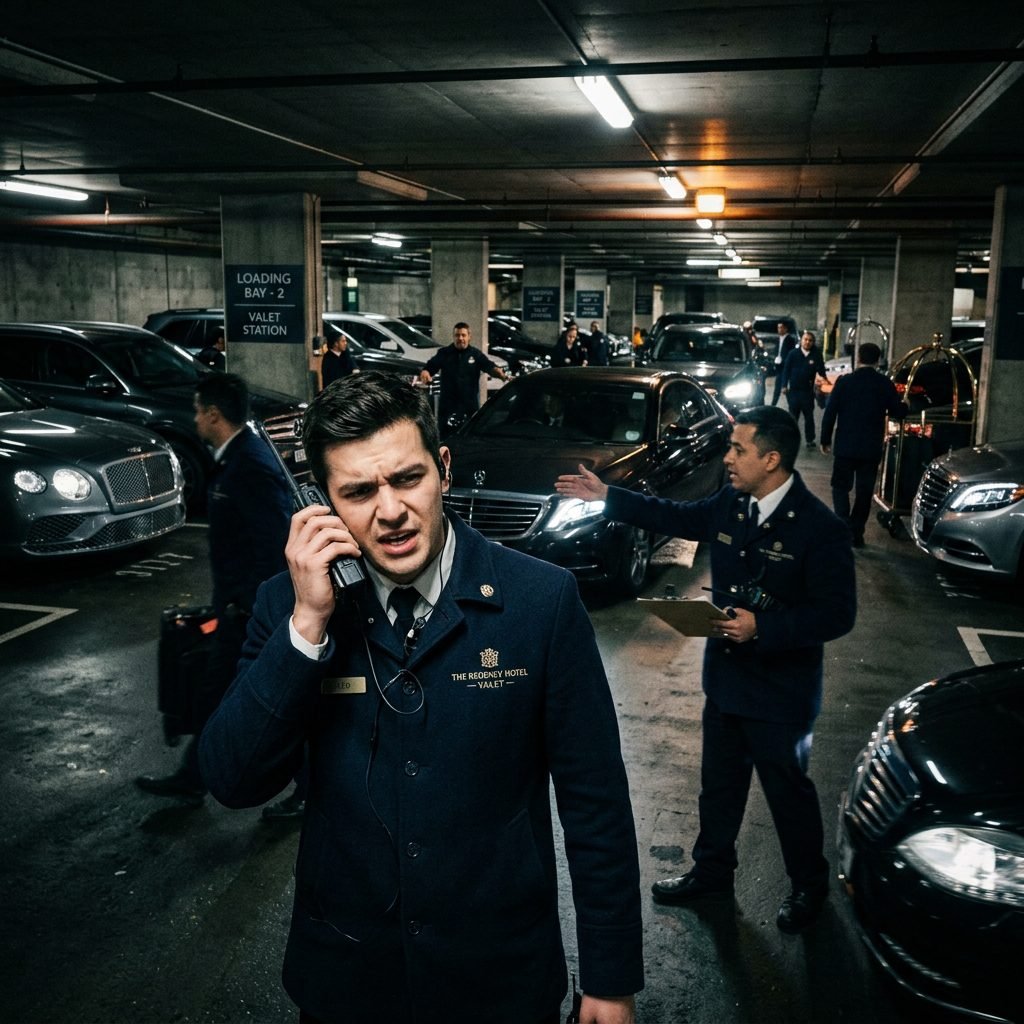
Without reliable radio coverage across the pool deck dead zone, the hotel's operations teams had fragmented into siloed communication — each zone working independently because coordinating across floors had become too unreliable. Guest-facing services suffered most, where seconds-level confirmation is part of the job.
- Valet and parking B2 operated on entirely different communication loops — no reliable bridge
- Engineering calls between basement plant rooms and upper-floor maintenance went unanswered
- F&B and kitchen coordination across building zones defaulted to phone calls and walking
Replacing Radios That Were Never Broken
The hotel's response to the dead zone problem was the logical one: assume the P6600i units were defective and replace them. Multiple batches were purchased over two years. Each replacement cost the same as the last — and changed nothing. Without a proper RF site survey, every purchase was money spent on the wrong diagnosis.
- First replacement batch: same coverage failure within weeks of deployment
- Second replacement batch: identical result — problem persisted across all zones
- Zero vendor support on root cause — each sale simply recommended newer models
- True cost: radio purchases + staff time + guest service failures + management frustration
When Octogen ran the RF site survey, the culprit was immediately clear: the Level 8 pool deck was acting as a signal wall. Every reinforced concrete slab, every metre of standing water, was absorbing and scattering the radio frequency. No handheld radio — regardless of brand, wattage, or price — could overcome structural RF attenuation at this scale. The P6600i was performing exactly as designed. The hotel had not been buying inferior radios. They had been fighting their own building.
4 things Octogen did at Corsair Hotel
Not a radio swap — a structural RF problem required an infrastructure answer. Octogen designed the SLR5300 deployment specifically around the hotel's building geometry and dead zone profile. Click each step to explore.
What hotel-wide comms looks like in real time
This is real channel activity from the Corsair Hotel's overnight operations — the same shift that previously relied on walkie-talkies that couldn't cross Level 8.
4 channels · 40 devices · 56-floor tower · 0 signal incidents in 2 years
2 days — from site survey to live hotel comms
RF Site Survey
- 09:00Octogen team on-site — RF testing equipment deployed to Basement B2
- 10:30Level 8 pool deck tested: complete signal null confirmed across all P6600i units tested
- 13:00Floor-by-floor survey completed B2 to Level 56 — 10 measurement points documented
- 15:00SLR5300 placement design and antenna routing plan delivered to facilities team
Installation & Handover
- 08:00SLR5300 unit mounted in equipment room — antenna cabling commenced through service riser
- 10:30Antenna endpoint installed at B2 car park ceiling — first live radio test: basement confirmed clear
- 12:00Antenna endpoint installed Level 1 lobby — cross-pool bridge live, full B2-to-L56 confirmed
- 15:00Full floor-by-floor live test with hotel's own P6600i radios — all zones clear, team signed off
2-Day Deployment Scorecard
Numbers don't lie
We had spent years assuming the P6600i radios were the problem. Octogen's site survey took one day to show us we were completely wrong — the Level 8 pool deck was blocking every cross-building signal, and no radio upgrade would have ever fixed that. The SLR5300 went in, and from that day forward we have not had a single communication complaint across any floor or zone. Two years later, Octogen still comes back every year to check the system. That consistency is what we needed from a partner, not just a vendor.
Things you probably want to know
Your building is not the enemy. But it needs to be planned for.
Corsair Hotel replaced their radios twice before solving the real problem. You don't have to wait that long.